
August 3, 2026 · HVAC Expertise 2025
Oilfield HVAC Services in the Permian Basin: Keeping Your Equipment and Crew Cool
Expert oil field HVAC services keep Permian Basin rigs cool, safe, and running 24/7 with certified, explosion-proof systems.
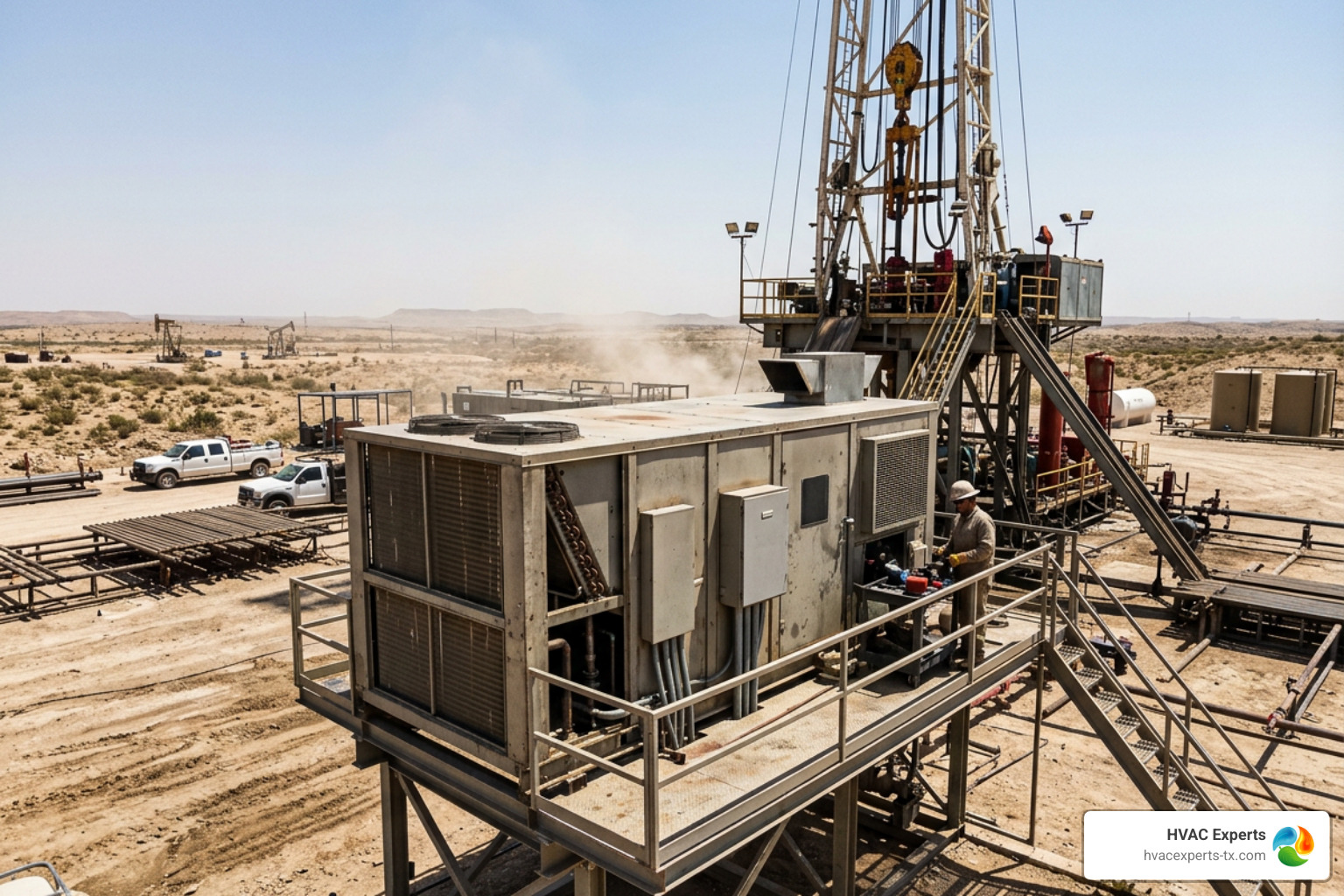
When the Heat Won’t Quit: Why Oil Field HVAC Services Are Mission-Critical
Oil field HVAC services are specialized heating, ventilation, and air conditioning solutions built for the extreme demands of oil and gas operations, from drilling rigs and compressor stations to crew quarters and control rooms.
Here’s what they cover at a glance:
| Service Type | What It Does |
|---|---|
| Field office climate control | Keeps workers safe and productive in extreme heat or cold |
| Control room pressurization | Prevents hazardous gases from entering sensitive spaces |
| Explosion-proof equipment | Safe operation in Class I Division 1/2 hazardous locations |
| Crew quarter HVAC | 24/7 comfort for rotating shift workers |
| Emergency repair and deployment | Fast response when downtime costs thousands per hour |
| Preventive maintenance programs | Scheduled service to avoid costly unexpected failures |
The Permian Basin doesn’t give HVAC systems an easy life. Summer temperatures regularly hit triple digits. Dust storms roll through without warning. Hydrogen sulfide and other corrosive gases eat through standard equipment fast. And unlike a commercial office building, oil field operations run 24 hours a day, 7 days a week. There is no convenient time for a breakdown.
When a system fails on a drilling rig, the clock starts immediately. Unplanned stoppages can cost thousands of dollars per minute of lost production. That’s not a residential HVAC problem. That’s an industrial emergency.
This guide explains everything you need to know about oil field HVAC services in the Permian Basin, including the unique challenges, the right equipment, safety compliance requirements, and how to keep your crew safe and your operations running.
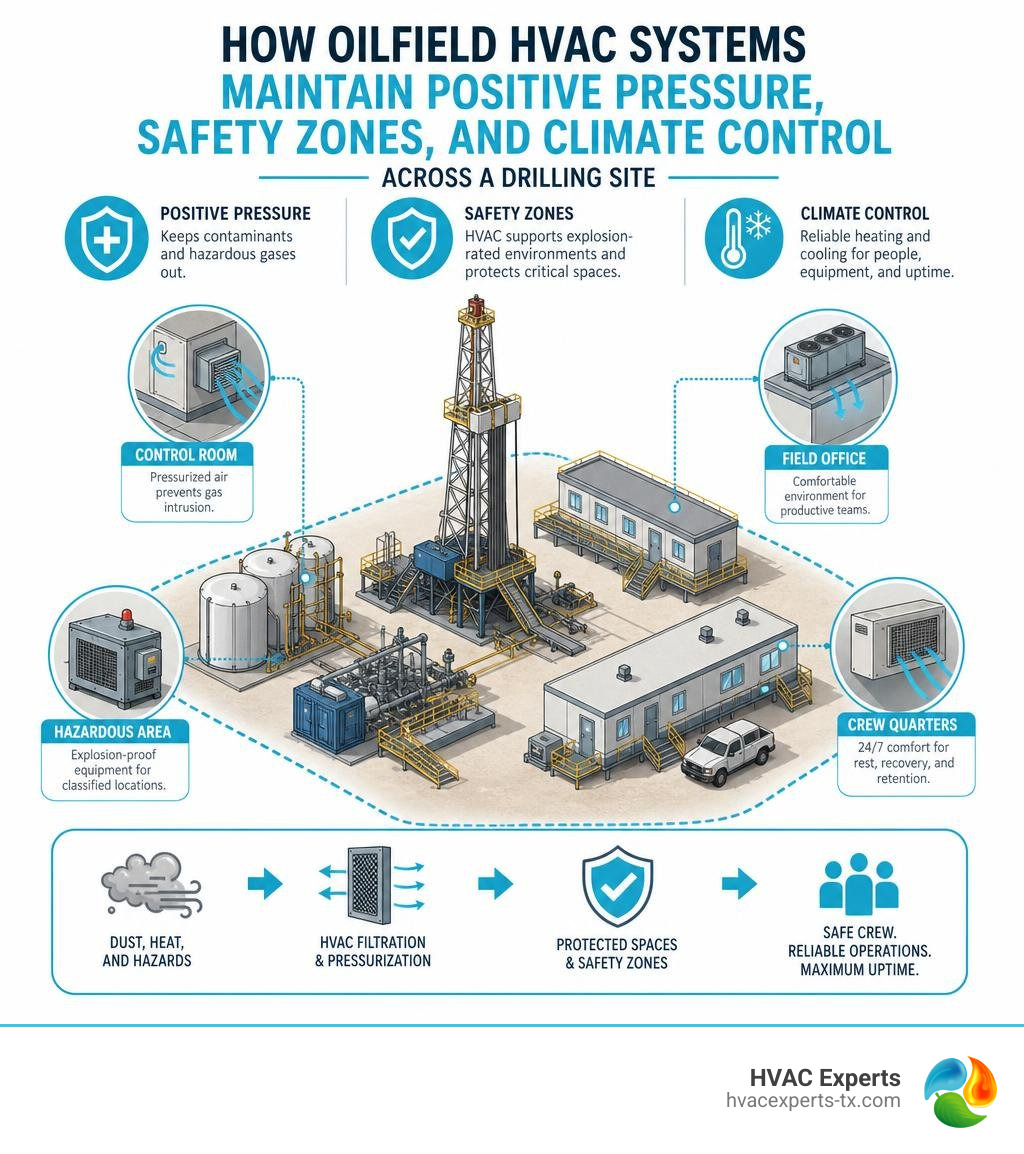
The Harsh Reality of Basin Conditions: Environmental and Operational Challenges
Operating in West Texas means dealing with some of the most unforgiving weather on the planet. For our teams working across Odessa, Midland, Pecos, Orla, and Kermit, the environment is a constant adversary.
Standard residential or commercial air conditioners are built for manicured lawns and suburban rooftops. Place those same units on a remote drilling pad in the Permian Basin, and they will choke on dust, overheat in the baking sun, or corrode from exposure to sour gas in a matter of months.
The primary environmental threats to oilfield HVAC systems include:
- Extreme Thermal Swings: Summer afternoons routinely push past 105°F, placing immense pressure on compressors. Conversely, winter nights can plunge well below freezing, requiring reliable heating systems to protect both crews and sensitive electronics.
- Heavy Dust and Sand Infiltration: Fine silica dust from drilling operations and West Texas windstorms acts like sandpaper on internal components. It quickly clogs standard air filters, chokes condenser coils, and causes fan motors to burn out prematurely. The same field conditions that make drilling rig HVAC ducts so difficult to maintain also make routine filtration, coil cleaning, and duct inspections essential.
- Corrosive Gases: The presence of volatile organic compounds (VOCs) and highly corrosive hydrogen sulfide ($H_2S$) gas in oil-producing regions accelerates the degradation of copper coils and electrical connections, leading to refrigerant leaks and electrical shorts.
Combating Dust, Sand, and Corrosion in Oil Field HVAC Services
To survive these conditions, industrial HVAC systems require heavy-duty engineering and specialized materials.
First, we utilize advanced multi-stage filtration systems. High-capacity particulate filters capture fine sand and dust before they can reach the evaporator coils.
Second, we protect the structural integrity of the units. Standard galvanized steel cabinets are replaced with heavy-duty 16-gauge powder-coated steel or marine-grade 316 stainless steel.
Crucially, the copper coils, which are highly susceptible to acid and sulfur corrosion, are treated with specialized baked phenolic protective coatings such as Heresite, Technicoat, SpecificCoat, or Ecoat. These coatings create an impenetrable barrier against corrosive atmospheres, extending the lifespan of the equipment by several years and preventing premature system failures.
Industrial vs. Commercial: What Makes Oil Field HVAC Services Unique?
Many fleet managers and site operators ask us why they cannot simply hire a standard commercial contractor to service their oilfield assets. The short answer is that the operating parameters, safety protocols, and stakes are completely different.
In a standard commercial setting, an HVAC failure is an inconvenience that might send office workers home early. In the oil and gas industry, an HVAC failure can shut down an entire pipeline station, ruin millions of dollars in variable frequency drives (VFDs), or compromise worker safety in a hazardous zone.
| Feature | Commercial HVAC Services | Oil Field HVAC Services |
|---|---|---|
| Operating Hours | Typically 8 to 12 hours a day, 5 days a week | Continuous 24/7/365 operation under high load |
| Environmental Exposure | Mild urban/suburban air, controlled roofs | High dust, sand, extreme heat, and corrosive chemical exposure |
| Safety Requirements | Standard OSHA compliance, basic electrical codes | Hazardous locations (Class I Div 1/2), hot work permits, $H_2S$ training |
| Downtime Tolerance | Moderate (repairs can often wait until the next business day) | Zero tolerance; downtime can cost thousands of dollars per minute |
| Equipment Design | Standard off-the-shelf package units and split systems | Explosion-proof, pressurized, redundant, and custom-fabricated systems |
Our commercial HVAC services are built for demanding business environments, but when HVAC Experts deploys to active oilfield sites, our technicians operate under an entirely different set of rules, tools, and safety standards.
Critical Applications: Specialized Equipment for Oil and Gas Operations
Oilfield HVAC services cover a broad spectrum of specialized facilities, each with its own unique climate control and ventilation requirements:
- VFD and MCC Buildings: Variable Frequency Drive (VFD) and Motor Control Center (MCC) buildings house the electrical “brains” of drilling rigs and pipeline stations. These electronics generate massive amounts of heat. If the HVAC system fails, the drives will overheat and trip, instantly shutting down operations. We often configure these with reverse-airflow systems, using top return and bottom supply, to pull heat away from critical components efficiently.
- Driller’s Cabins: Positioned right on the rig floor, the driller’s cabin requires robust, compact climate control that can withstand intense vibration, extreme heat, and hazardous gas risks.
- Modular Field Offices and Crew Quarters: Portable buildings provide essential operational space and rest areas for crews working long shifts. These require reliable, high-static package units or mini-split systems to ensure proper air exchange and comfort.
- Control Rooms: Centralized control centers require precise temperature and humidity control to protect SCADA networks and process automation servers, alongside positive pressure systems to prevent toxic gas ingress.
The Permian Basin’s remote operating conditions are exactly why HVAC Experts built dedicated commercial HVAC services for high-load facilities, field offices, and industrial workspaces that cannot afford ordinary comfort-cooling failures.
Custom Fabrication and Rapid Deployment for Remote Sites
No two oilfield layouts are identical. Remote sites often require custom sheet metal and ductwork fabrication to fit non-standard modular buildings, pressurized trailers, or skid-mounted equipment.
We provide in-house custom fabrication to design heavy-duty, corrosion-resistant duct systems capable of handling high-volume airflow under extreme static pressure. This allows us to rapidly deploy complete, pre-configured HVAC skids to remote locations, minimizing installation times and ensuring seamless integration with existing site infrastructure.
Safety Compliance and Hazardous Location Certifications
Safety isn’t just a priority in the oilfield; it is a regulatory and operational absolute. Standard air conditioning units utilize electrical contacts, relays, and fan motors that can generate tiny sparks during normal operation. In an environment where flammable gases or vapors may be present, a single spark can have catastrophic consequences.
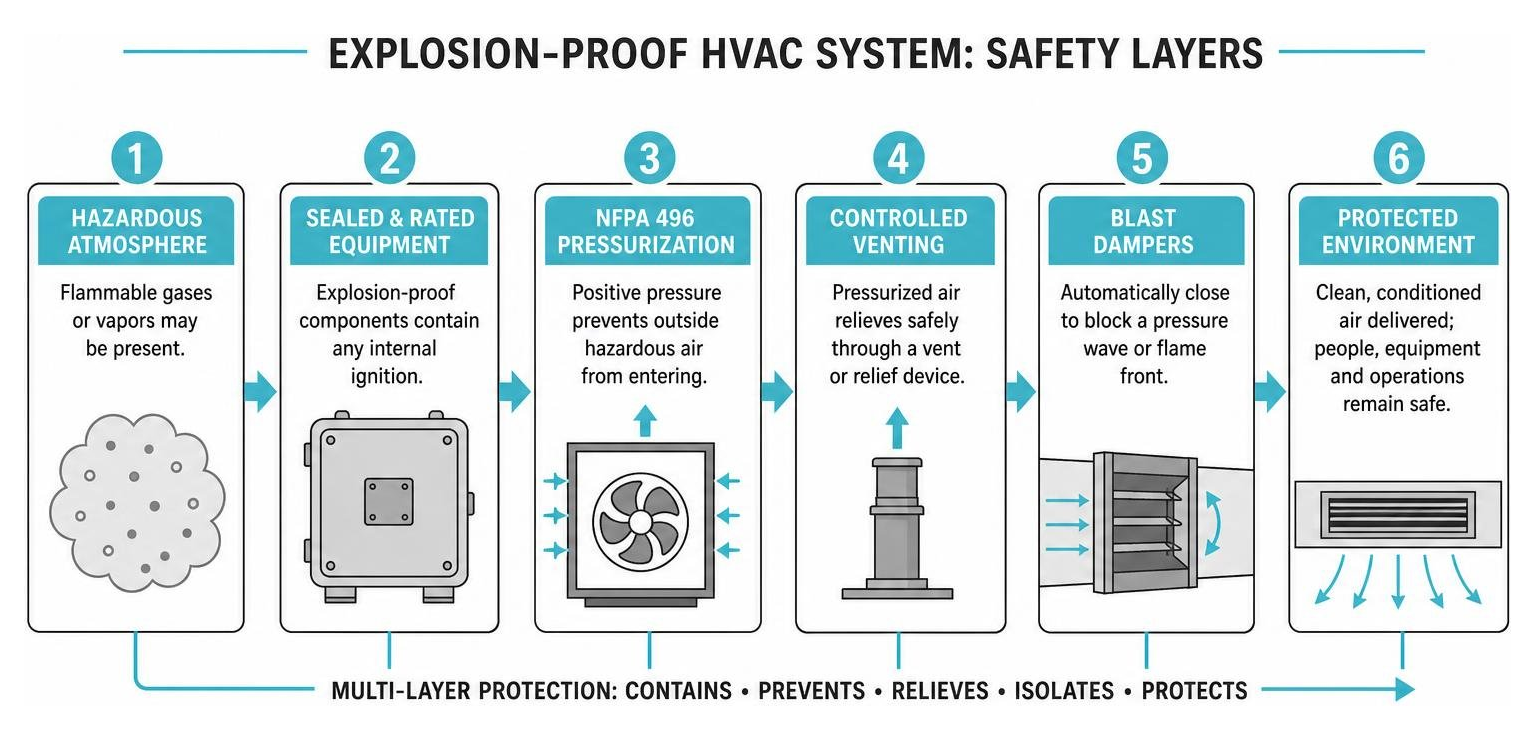
Explosion-Proof Engineering and Oil Field HVAC Services
To safely operate in these environments, HVAC systems must be engineered for hazardous locations. These are classified under strict regulatory frameworks:
- Class I, Division 1 (Group C & D): Areas where ignitable concentrations of flammable gases, vapors, or liquids exist continuously or frequently under normal operating conditions.
- Class I, Division 2 (Group C & D): Areas where flammable substances are handled but are normally confined within closed systems, escaping only in the event of an accidental rupture or equipment failure.
Explosion-proof HVAC systems prevent ignition through several critical engineering features:
- Spark-Resistant Components: Utilizing explosion-proof, totally enclosed fan-cooled (TEFC) condenser motors and spark-resistant aluminum blower wheels (AMCA Type A).
- Purge and Pressurization Systems (NFPA 496): These systems introduce clean, compressed air or inert gas into the electrical enclosure to maintain a positive pressure, preventing flammable gases from entering and coming into contact with active electrical components.
- Intrinsically Safe Controls: Low-voltage control circuits designed so they do not release sufficient electrical or thermal energy to cause ignition.
- Blast and Fire Dampers: Heavy-duty, fast-closing mechanical dampers designed to isolate ductwork, protect ventilation paths, and prevent the spread of fire, smoke, or blast forces through the system.
Minimizing Costly Downtime: Preventive Maintenance and Redundancy
In remote oilfield locations, a simple component failure can take hours to repair just due to travel times. When unplanned drilling stoppages can cost thousands of dollars per hour, relying on a reactive “run-to-failure” approach is incredibly expensive.
To mitigate this, we focus heavily on redundancy and proactive maintenance.
For critical infrastructure like VFD shelters and control rooms, we highly recommend N+1 redundancy configurations. By installing multiple smaller units with lead-lag controllers, the system can automatically cycle between units to balance run hours. If one unit experiences a compressor failure, the secondary unit instantly ramps up to handle 100% of the cooling load, preventing any operational downtime.
Additionally, utilizing two-stage cooling systems provides an inherent 50% refrigeration backup, keeping your electronics operational while our technicians are en route. A broader look at why HVAC Experts is trusted for HVAC services in the Permian Basin shows how 24/7 response, preventive planning, and local field knowledge all support reliable oilfield operations.
Recommended Maintenance Protocols for Remote Facilities
Implementing a structured preventive maintenance program is the single most effective way to extend equipment life and prevent emergency call-outs.
We recommend the following maintenance checklist for remote oilfield HVAC systems:
- High-Frequency Filter Changes: Inspect and replace air filters every 30 to 45 days or more frequently during active dust storm seasons.
- Coil Cleaning and Inspection: Wash condenser and evaporator coils to remove dirt buildup, sand, and chemical residues that restrict heat transfer.
- Thermostat and Control Calibration: Test and calibrate thermostats, programmable controls, and safety sensors.
- Refrigerant Level Monitoring: Check refrigerant pressures and inspect lines for any signs of vibration-induced leaks.
- Belt and Pulley Lubrication: Inspect belt wear, adjust tension, and lubricate fan motor bearings.
- Electrical Panel Audits: Inspect UL-listed electrical panels, tighten loose connections, and check contactors for pitting or wear.
- Pressurization and Damper Testing: Verify that positive pressure systems and fire/blast dampers operate correctly.
Frequently Asked Questions About Oil Field HVAC Services
What certifications should an oil field HVAC provider hold?
When hiring an HVAC provider for active well sites or midstream facilities, you must ensure their technicians are fully licensed, certified, and trained to work in hazardous environments. Look for providers whose teams hold:
- TDLR Licensing: Texas Department of Licensing and Regulation credentials for commercial/industrial work.
- EPA Section 608 Certification: Required for handling refrigerants.
- Safety Training: SafeLandUSA, OSHA 10/30, $H_2S$ Clear, and site-specific hazard training.
- Hazardous Location Familiarity: Deep knowledge of NEC codes, NFPA 496, and explosion-proof equipment standards.
Industrial oilfield services in West Texas require a team with heavy-duty safety credentials and specialized industrial expertise.
How do HVAC systems protect workers from hazardous gases?
In facilities located near active production or processing areas, indoor air quality is vital. Indoor air can be up to five times as polluted as outdoor air if not properly managed.
HVAC systems protect workers by maintaining positive pressure inside temporary refuges, control rooms, and offices. This positive pressurization prevents hazardous gases like $H2S$ or methane from leaking into the building through doors or seams. Specialized chemical filtration systems, including carbon and $H2S$ scrubbers, actively filter incoming fresh air to ensure the breathing environment remains completely safe.
Why is redundancy so critical for remote oilfield equipment?
Unmanned pipeline stations, VFD buildings, and remote compressor sites are often located miles away from the nearest town. If an HVAC system fails on a hot summer afternoon, internal temperatures in these metal enclosures can exceed 140°F in less than an hour, causing critical computer systems, SCADA networks, and motor drives to fail. Redundancy ensures that a single component failure does not cascade into a multi-million dollar operational shutdown.
Conclusion: Partner with the Permian Basin’s HVAC Experts
Managing an oilfield operation in West Texas is a massive logistical challenge. You shouldn’t have to worry about whether your cooling systems are going to survive the next dust storm or heatwave.
At HVAC Experts, we provide robust, reliable, and compliant oil field HVAC services tailored to the unique demands of the Permian Basin. Whether you are operating in Odessa, Midland, Andrews, Pecos, Monahans, Kermit, Crane, or Orla, our team is equipped to handle everything from custom sheet metal fabrication to explosion-proof system design.
We understand that in the oilfield, time is money. That’s why we offer 24/7 emergency services to get your critical systems back online when every minute counts. For the ultimate peace of mind, our Diamond Club membership offers priority scheduling, regular preventive maintenance, and exclusive discounts, ensuring your systems are always ready for whatever the West Texas weather throws their way.
Ready to protect your equipment and keep your crew safe? Contact our oil field HVAC specialists to schedule your industrial consultation. Let us keep your operations cool, compliant, and running strong.
4.9 · 1,899 Google reviews
Need help at home?
Call 432-272-5636 for a free estimate.